
HC #2: Taming my anxiety with a lesson from the English Scone
Why worry doesn’t make you a good person and what to do instead

By the way, I wrote a whole article HERE on how we shouldn’t worry about being a good person, but it’s so endemic in my society and so intertwined with worry that I couldn’t help but write about it again. Forgive me, I’m contradictory!
If you ask me why I think negative energies exist, the modern tendency to substitute worry for actual assistance is, like, Evidence #1 or #2.
Consider the following dialogue (admittedly, it’s imaginary, but I bet you resonate with it):
“I’m so worried about my nephew.”
Well, have you reached out to him to see what’s going on?
“No, but my sister says he’s really struggling in school.”
Oh, have you sent him a letter to encourage him and say how much he means to you?
“No, I don’t really write letters.”
How about texting him and asking if he wants to jump on a Zoom call and check in?
“Well, he’s really busy. And he’s working so hard in school. I wouldn’t want to distract him…”
(Btw, this has nothing to do with my actual sister and my actual nephew who both seem to be doing fine…)
FOOD FOR THOUGHT: Is there a place in your life where you’re worrying instead of acting?
If so, take a moment and give yourself a pat on the head (please do it physically right now!) because reading this article is going to help.
We spend a huge amount of time worrying about other people and often our ourselves…without actually taking any action to assist.
Did you know that worrying is designed to put your senses and muscles on high alert to respond to threats to life and limb? That means that worrying while lying in bed, for example, is completely useless unless you are anticipating a Viking-style raid where somebody comes to stab you in your bedroom.
Most of the things we “worry about” today are actually terribly suited to worrying… because, really, we should be problem-solving and taking action, not waiting for a threat.
My Spirit guide said, “You know, humans are the only animal that regularly gets to make a free-will choice about how it uses resources.”
What if we did that with worry?
In this article
What I learned from scones and worrying
This week’s example
Get off the “Worry Cycle”
Get on the “Progress Bus”
So why do we still choose worry?
For now, try this
I used to think I was supposed to worry.
After all, it made me a good person. It showed I cared, right? Wasn’t I supposed to worry about all those people suffering?
(My spirit guide pointed out that if I was supposed to be unhappy if other people were suffering…I would actually never be happy because there’s always somebody suffering.)
I might have gotten the idea that the worry cycle was PERPETUAL from my therapists who were always eager to discuss this week’s worries.
And I thought not worrying made me foolish because I grew up with a message that there were threats all around me…even though I didn’t see them in 1970s suburban Santa Cruz, California.
It definitely felt like I was insufficiently paranoid.
So, as a kid, I deliberately ramped up my fear, a habit I’m still dealing with.
My friend said that worrying made her feel safer, like she was on alert. Although she never mentioned what she thought she had to be on alert against…
But what never occurred to me was that the worry cycle might be something that I had evolved with… and could say “no” to.
Because it was actually sapping my will to act…
If you could say “no” to worrying about one thing, what would that be?
What I learned from scones and worrying
The evolutionary adaptation of worry puts your system on high alert to scan for physical threats.
Like you notice “all of the birds in my environment have gone still, so maybe a predator has entered the area.”
But now that many humans are physically way safer but live in a much more complex environment, we really should be problem-solving instead of worrying.
What if I lose my job?
Should I take this opportunity to move?
Why are my psych meds making me feel creepy?
These are not really things we should “worry” about because they’re not immediate physical threats. We should be investigating and acting, not waiting to see what happens.

This week’s example
I’m editing a white paper on academia’s response to the climate crisis (no immediate physical threat involved). Yesterday, we had a Zoom meeting (a bit scary for me because I’m the only non-academic in the group). The meeting went well, but I had a worry avalanche afterwards:
One person said she had a hard time understanding a concept I’d written about (admittedly, I’d invented it, so it’s reasonable that it might need a little more explanation.)
But emotionally, I launched into a spiral:
My writing’s not clear enough
I’m doing a bad job
Even though they’ve liked my work until now, it only takes a single misstep for them to pull me off the project…(not true, btw)
But that worry pushed me to scan for potential threats and then wait for them to materialize…
…instead of objectively evaluating what happened and coming up with a solution.
Could I decide to be happy about knowing that I need to clarify the text in question? Better to find that out now than after the paper is published…
And that’s the point about the English scone.
Get off the “Worry Cycle”
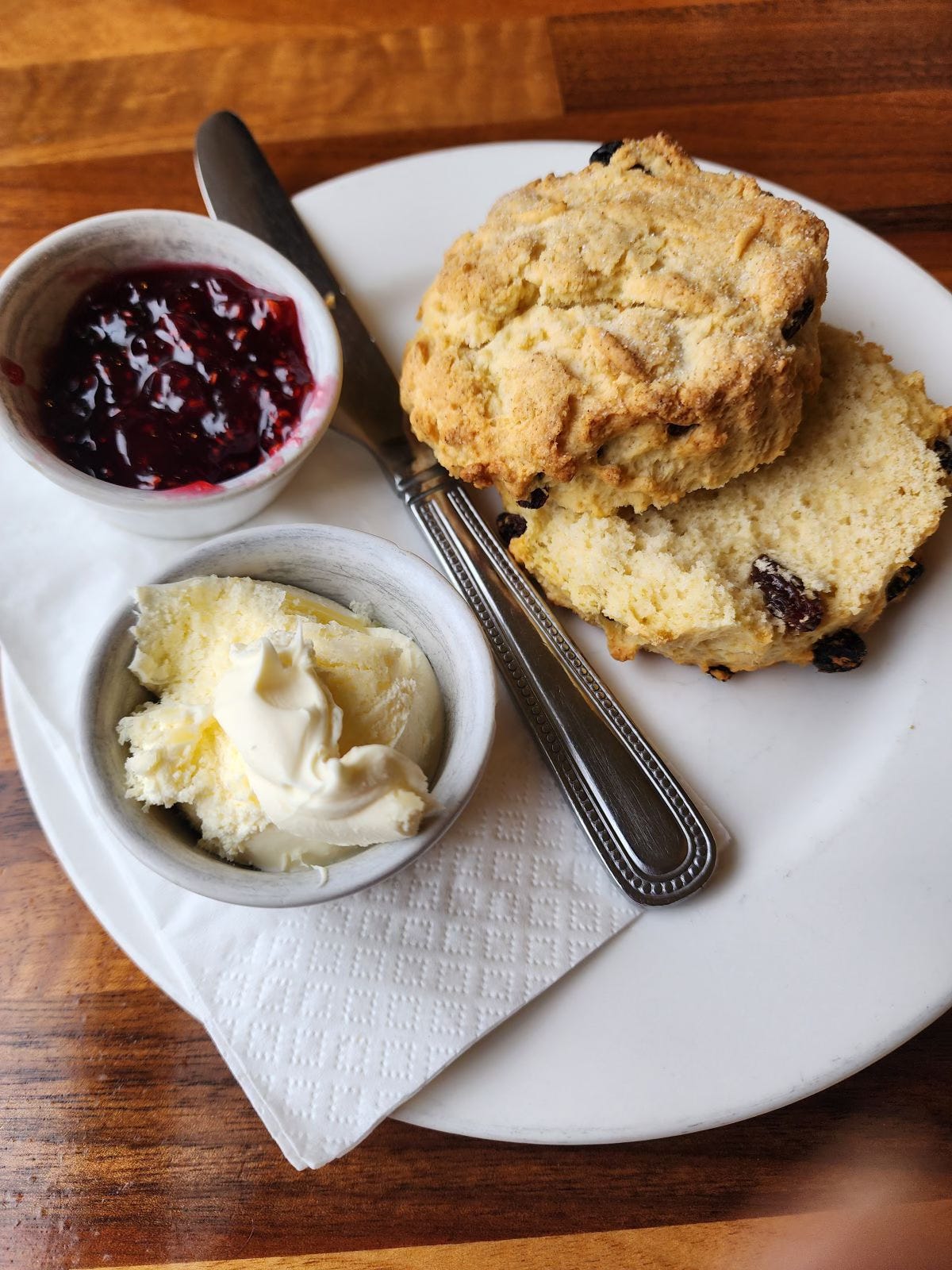
Devon and Cornwall are two counties in southwest England, and they’ve started a friendly rivalry over the correct way to prepare a scone: jam or cream first?
A rivalry that a server in York, England decided I needed to worry about!
“Are you Devon or Cornwall?” The question was delivered in a very posh BBC-style accent.
Sometimes, as a traveler, I’ve found it’s best to be honest when I’m confused. “What?”
“Devon or Cornwall?” Repeated more slowly as though that would help me understand.
My blank face must have engendered some sympathy in our server in Bailey’s Tea Room in York, England. She dropped the plummy tones.
“Ya see, luv, there’s two ways to put on the clotted cream and jam. In Devon, they put the cream on first and then the jam. But if you put the jam first, you’re in Cornwall. Can’t straddle the fence, luv! Gotta take a side.”
She gave me a saucy wink and walked away.
Was she trying to fluff up a little bit of British culture for the American tourist?
Was it a tiny power play where she got to assert her knowledge over me?
Whatever the motivation, it isn’t something to worry about. Despite what she said, there is absolutely no need to pick a side. I can cheerfully straddle that fence as long as I want!
And, honestly, if you’re “worried” about the order to put jam and cream on your scone, you’re doing pretty damn well! Like, if that’s the biggest thing on your radar, how high on Maslov’s pyramid of needs are you living?
I’ve learned to celebrate the chance to “worry” about such small things because that I’m not experiencing a threat to life and limb.
If you’re worried about things like where your kid is going to college or how to improve a tense relationship with a family member that you’re still speaking to, or whether your next Substack article will get good engagement… take a moment to congratulate yourself for doing very well on the grand scale of human life for the last 250,000 years.
Do that now! (I’ll wait…)
Because I’ve realized something: worry has a cost. It’s inimical to happiness.
As long as I allow worry in my life, I am basically squeezing out happiness.
And that is a free-will choice, no matter how much my childhood trained me to be paranoid or I’m bombarded by non-stop MSNBC bad news visiting my in-laws.
Because I can choose something else.
Do you have a chronic “worry” where you’d like to choose to be grateful that this thing on your radar is not, in fact, a life-threatening event?
Congrats for taking a moment to reframe your perspective! You win!
Get on the “Progress Bus”
Problem-solving does not conflict with happiness.
In fact, it contributes to it.
I love problem-solving.
(That’s part of what got me through 25 years of SAT tutoring. I didn’t like the test, but I did like my students, and I loved brainstorming different ways to solve geometry problems.)
So satisfying to have everything all wrapped up with a plan for moving forward!
Feeling good that you’re doing something productive instead of just stewing in your worries (double pat on the head for you!)
Impressed at your own resourcefulness as you come up with multiple options.
Supported by your community when you get outside input.
Confident in yourself as you think through the options and decide.
So why do we still choose worry?
My husband said it: “Worry is easier… it doesn’t ask anything of us.”
Worry is a reactive state where you wait for something to happen before you respond.
Perfect for lying in bed.
Perfect for procrastinating.
Perfect for feeling like you are caring without actually having to do anything that might impact somebody else’s life…and push you out of your comfort zone.
Those long-range, big-picture worries about the “state of the world” are the very worst type of worry, the most corrosive to happiness. Because people hardly ever actually do anything about them.
They’re vague, painful, and far away – perfect for feeling a lot but taking no action.
Arguably, the best thing you could do for people suffering far away is to become happier yourself and then use some of your extra energy to support them by:
Writing a letter to your political representative
Raising money for an aid organization
Engaging in intercessory prayer
Showing up at a rally or protest
Writing a letter to the editor or an article for an online magazine
Don’t kid yourself that wringing your hands or feeling butterflies in your stomach about suffering across the globe makes you a good, tender-hearted person. That’s the negative energies’ plan to remove you from the playing field.
For now, try this
Is there an area in your life where you could try stepping off the worry cycle and getting onto the problem-solving bus?
Just one!
Don’t tackle everything all at once.
Shoot for a tiny win you can celebrate.
Pick a single, small action that you can take today or tomorrow.
And once you’ve done it, reward yourself. That can be something small like a bubble bath, a walk in the park, or an extra half an hour to drink a cup of tea and read your favorite book. But celebrate having done something instead of just worrying.
Once you’re in the driver seat, with your hands on the wheel, I bet you feel much better. And you’ll be much more effective.
If you feel drawn to chronic worry, try asking yourself “What action am I avoiding?”
None of my climate white-paper collaborators said my concept of “people-centered innovation” was bad, just that they didn’t understand it. In fact, they were curious, and once I elaborated, they seemed intrigued.
So I stopped worrying and wrote a better explanation!
Then I told my husband I wanted to celebrate. Double pat on the head for me!
I'm getting so much better at rewarding myself, and it’s making a big difference.
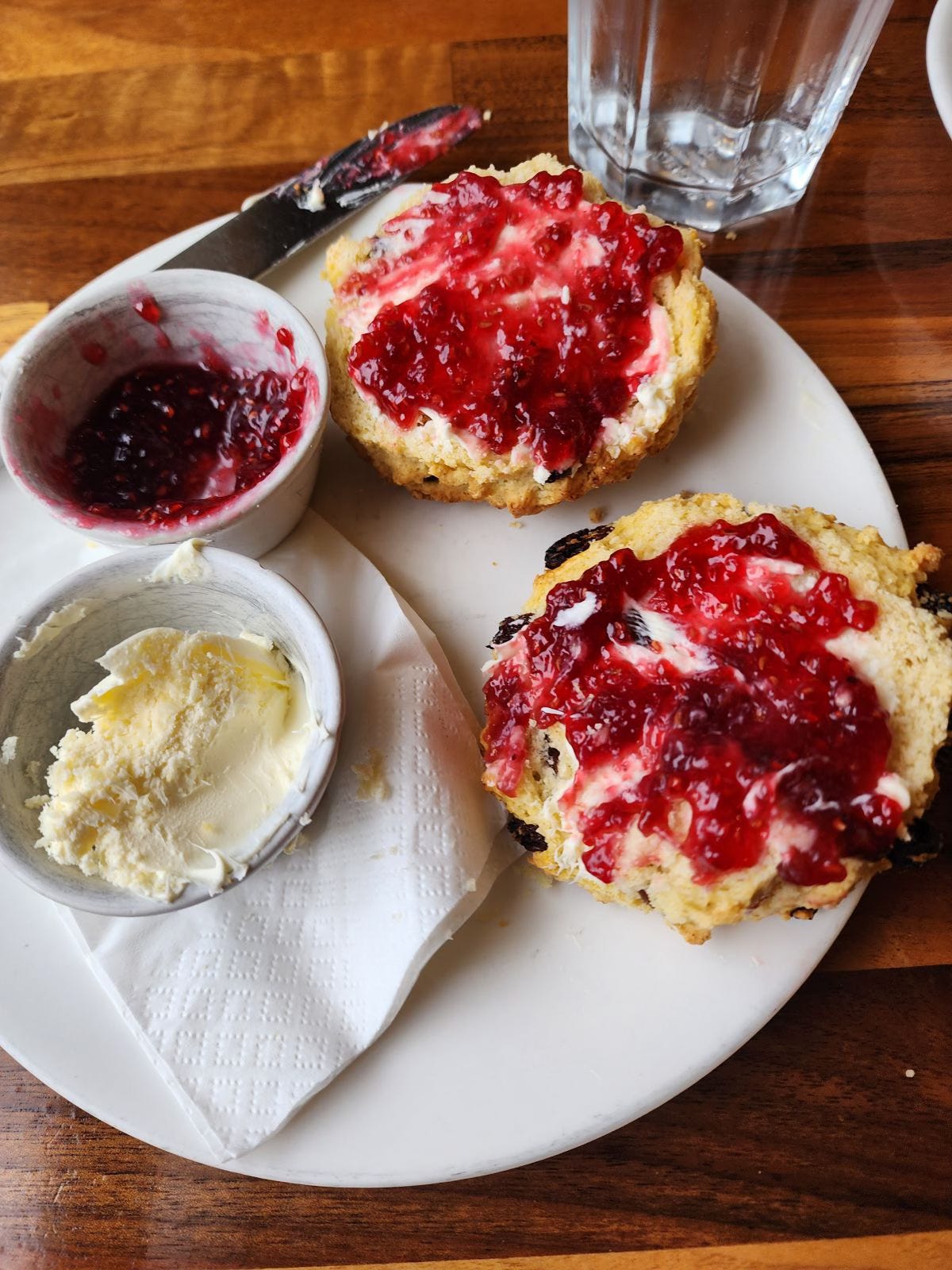
P.S. I did figure out the difference between the Devon and Cornwall scone-preparation methods for my dad when he asked months later in California.
If you put the cream on first and then the jam, the light goes through the translucent jam, bounces off the white cream beneath, and comes back out again, making the jam glisten like rubies. But it is a bit sticky when you eat because you end up getting jam all over your lips.
If you put the jam on first and then the cream, you lose the gorgeous, glistening jam. But the cream does prevent the jam from sliding off, and you get cream all over your lips instead, which is significantly less sticky.
So I think it’s like, do you like aesthetics (Devon) or convenience (Cornwall)? I’m an aesthetic girl myself. Devon all the way! Stickies be damned!
Thanks for this article. A problem-solving approach is better but sometimes the problem or the solution are so boring that we resort to worry or fear instead of facing them.
Wow i enjoyed reading this article for the very essence of it. I think since i chose Peace, i stopped worrying. I used to care about so many things that my time was spent trying to solve this and that and i later realized that wasn't even required of me. I stopped caring that way and decided to embrace my peace
Now i go out of my way for my KIDS but i have also accepted that even them they don't need me to go out of my way for them that way they just need me to be me.
I have accepted PEACE as my modus operandi